
The Foundation of Wind Energy: Engineering Stability from the Ground Up
Wind turbines are engineering marvels, capable of converting natural forces into clean energy. Yet while the towering blades and sleek towers often grab attention, the foundation beneath the surface is what truly ensures performance, reliability, and longevity.
Onshore wind turbines rely primarily on gravity-based and piled foundations. Choosing the right foundation requires careful consideration of turbine size, soil conditions, and environmental factors. Let’s explore the engineering behind these essential structures.
Gravity-Based Foundations
Best suited for: Strong, stable soils with good bearing capacity.
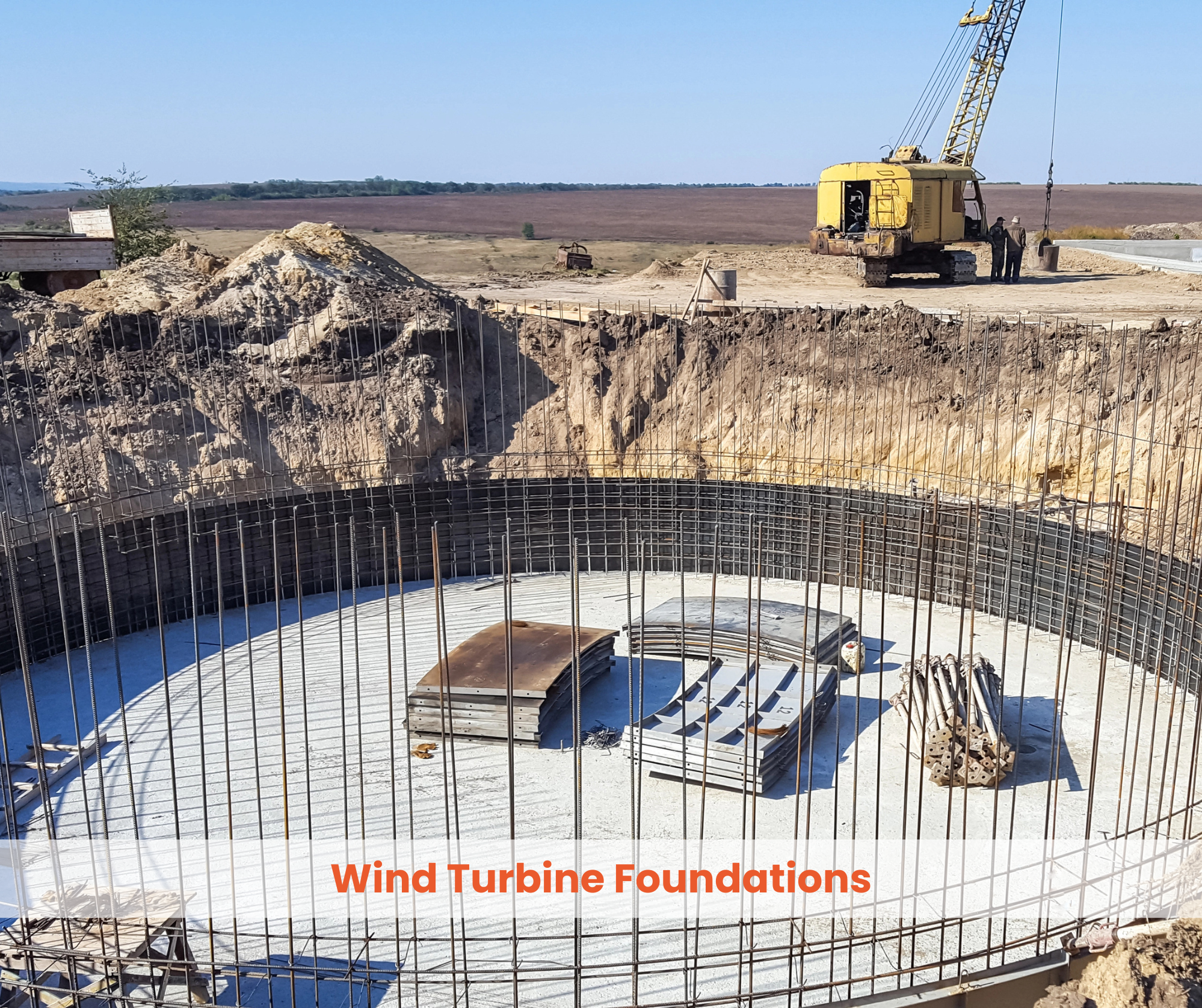
Gravity foundations are the most common solution for onshore wind turbines. Constructed primarily of reinforced concrete, they use mass and surface area to resist the forces generated by the turbine.
Engineering Details:
-
- Concrete Volume: Depending on turbine size, gravity foundations can contain anywhere from 200–800 cubic meters of concrete. For extra-large turbines (6+ MW), this volume can exceed 1,000 cubic meters.
- Reinforcement: Steel rebar is embedded throughout the foundation to increase tensile strength. The design typically includes radial and circular rebar patterns to distribute loads evenly.
- Anchor Bolts: High-strength steel anchor bolts are cast into the foundation to secure the turbine tower. These bolts are carefully positioned according to a bolt-circle design, often 6–12 meters in diameter for modern turbines.
- Load Management: The foundation must withstand vertical loads (tower weight), horizontal loads (wind force on the blades), and overturning moments. Its size, thickness, and weight are engineered to prevent settlement or tipping.
Advantages:
- Reliable and proven method for stable soil conditions
- Straightforward construction and well-understood performance
- Cost-effective for most onshore wind projects
Considerations:
- Requires extensive excavation and large quantities of concrete
- Large footprint may impact local terrain and require environmental planning
Piled Foundations
Best suited for: Sites with soft, weak, or variable soil conditions.
When near-surface soil cannot provide adequate support, piled foundations transfer turbine loads deeper into stronger soil layers or bedrock.
Engineering Details:
- Pile Types: Steel H-piles, tubular piles, or reinforced concrete piles are common.
- Depth: Piles are typically driven or drilled 10 – 30 meters into the ground, depending on soil strength and turbine size.
- Pile Cap: A reinforced concrete pile cap ties all piles together, distributing turbine loads evenly and serving as the interface for anchor bolts.
- Load Transfer: Unlike gravity foundations that rely on mass, piled foundations transfer loads through skin friction along the pile shaft and end-bearing at the pile tip, ensuring stability even in challenging soils.
- Design Complexity: Requires detailed geotechnical surveys to determine soil stratification, pile spacing, diameter, and length.
Advantages:
- Makes previously unsuitable sites feasible
- Provides strong resistance to vertical and lateral loads
- Can reduce excavation volume compared to gravity foundations
Considerations:
- Higher construction complexity and cost
- Requires specialized equipment for pile installation
- Longer construction timeline due to soil investigation and pile work
Engineering Considerations Across Foundation Types
- Soil Testing: Before foundation design, geotechnical engineers conduct borehole drilling, standard penetration tests (SPT), and soil sampling to determine bearing capacity, density, and stratification.
- Anchor Bolt Layout: Precision is critical; anchor bolts must align perfectly with the tower flange to ensure proper load transfer.
- Concrete Curing: Proper curing ensures maximum strength. Gravity foundations often require staged pours to prevent cracking in large slabs.
- Drainage and Frost Protection: Foundations may include drainage systems or frost collars to protect against water accumulation and freeze-thaw cycles.
- Safety Factors: Designs include safety factors for extreme wind events, seismic activity, and turbine operation over a 20-year lifespan.
Why Foundation Choice Matters
The foundation is more than just a base, it determines the turbine’s long-term performance and resilience. Gravity foundations rely on weight and footprint, while piled foundations rely on depth and anchorage. Both require meticulous planning, engineering, and construction to withstand decades of wind, weather, and operational stress.
At Williams, we provide engineered anchoring systems, fasteners, and reinforcement solutions that support the structural integrity of wind turbines. Strong foundations enable reliable energy production, and strong engineering ensures the future of renewable energy.