
Determining Proper Anchor Length
The length and load capacity of rock and soil anchor systems is dependent on many variables. Some of these variables are rock or soil properties, installation methods, underground or overhead obstructions, existing structures, right of way and easement limitations, anchor material strength and anchor type. Topics such as these should be evaluated during an anchor feasibility study prior to final anchor design. Final embedment depths should be determined on a project to project basis after reviewing rock or soil samples, previous experience and geological data. On-site anchor tests are generally the best way to accurately determine anchor lengths and capacities for the given geological conditions.
Free-Stress Length
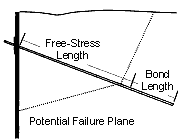
Prestressed or post-tensioned earth anchors must be designed with a free-stress length. This is the portion of the anchor length that does not provide anchorage to the soil or rock during the stressing procedure. The purpose of the free-stress length is to allow the installer to transfer an immediate anchor load directly to a specific location in the soil or rock. For instance, when designing tie back anchors, the free-stress length should be long enough to transfer the prestress load behind the predicted failure plane of the soil or rock mass. The free-stress length also helps to minimize load loss due to movement at the anchor head during load transfer from the stressing jack. The Post Tensioning Institute recommends that for prestressed rock or soil anchors utilizing steel bars, the free-stress length shall be a minimum of 10 feet, and for steel strand a minimum of 15 feet due to greater seating losses. PTI recommendations on free-stress length are based on anchors utilizing high strength post-tension steel and often have relatively high design loads. Lighter load prestressed mechanical rock anchors have been successfully designed and installed with overall lengths shorter than 10 feet in high quality rock.
Mechanical Rock Anchor Lengths
One method that is used to estimate the embedment depth for mechanical rock anchors such as Williams Spin-Lock system is based on rock mass pullout capacity. The mass of rock mobilized in uplift is approximately conical in shape and often is angled outward from the longitudinal axis of the rock anchor between 15 and 60 degrees depending on the site’s structural geology. The pullout capacity of the cone is a function of the weight of the cone and the shear resistance of the rock along the surface of the cone. Rock anchors are typically designed with embedments deep enough to ensure ductile failure of the steel bar. Mathematically, by setting the anchors ultimate steel capacity equal to the pull out capacity of the rock failure cone and applying necessary safety factors, a designer can estimate anchor embedment depth. Some designers neglect shear resistance and only use the weight of the cone for rock mass pullout resistance. This will typically provide a conservative anchor design.
The length of a mechanical rock anchor can be shorter than a cement grout or resin bond system since the load is being transferred by a mechanical head assembly rather than a grout or resin bond length. Therefore, the free-stress length plus the length of the mechanical head assembly makes up the embedment depth of the mechanical rock anchor. When anchors require couplers for longer lengths, Williams recommends the use of a hollow bar Spin-Lock for ease of grouting. Williams lists useful design charts which tabulate anchor steel capacity based on corresponding anchor diameters and recommended safety factors. This section also reviews installation procedure and provides detailed information on Spin-Lock accessories and components.
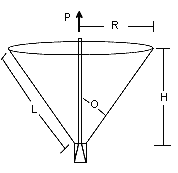
Mechanical Head Assembly
R = Radius of cone base
H = Height of cone
L = Incline length of cone
V = Volume of cone (right angle cone) = (1/3)()(R²)(h)
S = Rock shear resistance multiplied by the rock cone interface surface area
FS = Factor of Safety (.5 for a 2:1 Safety Factor)
Y = Unit Weight of rock (approx. 150 pcf dry)
U = Ultimate tensile strength of anchor rod
O = Cone Angle
P = Applied Design Load
π = 3.14
[(V)(Y) + S] > P < [ U / FS ]
Mechanical Soil Anchor Lengths
Williams Form Engineering offers the Manta Ray mechanical soil anchors. Manta Ray anchors can hold a maximum of 20,000 lbs, depending on soil properties and size of the Manta Ray head assembly. Their advantage is ease of installation, as no drilling or grouting is typically required. The anchor is simply driven into the soil with a driving hammer. Holding capacities for the Manta Ray anchors are shown on here.
Bonded Rock Anchor Lengths
Embedment depths for prestressed resin or cement grout bonded rock anchors are often determined by using the rock cone method as described under Mechanical Rock Anchor Lengths. However, unlike the mechanical anchor, the bonded anchor must also include a bond length in the embedment depth. The bond length allows the applied tensile load to be transferred to the surrounding rock. Therefore the embedment depth of a prestressed bonded rock anchor is made up of the free-stress length and the bond length. When using the rock cone method, a conservative approach would be to assume the pullout cone starts at the top of the bond zone. The bond length can be estimated by using the following equation, however test anchors are generally the best way to determine anchor embedments and capacities. Typical values shown below are from the Post-Tensioning Institute. They are not meant to be used for final design. Final bond stresses should be determined after the review of sample cores, previous experience and geological data.
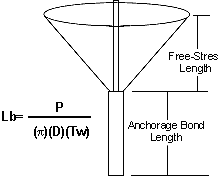
Average Ultimate Bond Stress Estimates for Various Rock
P= Design Load for the anchor
 = 3.14
D= Diameter of the drill hole
Lb= Bond Length
Tw= Working bond stress along the interface between the rock and grout (The working bond stress is normally 50 percent or less of the ultimate bond stress.)
Note= The ultimate bond stress between the rock and the anchor grout is estimated by a value of 10% of the unconfined compressive strength of the rock, but not more than 450 psi (3.1 MPa).
| Ultimate Grount/Bond Stress Estimates for Various Rock (from PTI) |
|
| Granite and Basalt | 250-450 psi |
| Dolomitic Limestone | 200-300 psi |
| Soft Limestone | 150-200 psi |
| Slates and Hard Shales | 120-200 psi |
| Soft Shales | 30-120 psi |
| Sandstones | 120-250 psi |
| Concrete | 200-400 psi |
Bonded Soil Anchor Lengths
Embedments for prestressed soil anchors consist of a 10 foot minimum free-stress length (for bar anchorages) and typically 20-40 feet of bonded length. Anchor drilling and grouting methods can have significant impact on soil bond stress values therefore final bond lengths are often determined by specialty anchor contractors. Shown below is a chart that can be used to estimate anchor bond length. This chart is for straight shaft anchors installed in small diameter holes using low grout pressure. However, final anchor capacity should be determined from field testing the anchors. For further guidance and recommendation on the design of prestressed bonded soil and rock anchors, refer to the Post-Tensioning Institutes manual on rock and soil anchors. Also refer to AASHTO for applicable publications.
| Estimated Average Ultimate Bond Stress for Determining Soil/Grout Bond Lengths (taken from PTI) | |||
| Cohesive Soil | Cohesionless Soil | ||
| Anchor Type | Average Ultimate Bond Stress at Soil/Grout Interface (PSI) |
Anchor Type | Average Ultimate Bond Stress at Soil/Grout Interface (PSI) |
| Gravity Grouted Anchors (straight shaft) | 5 – 10 | Gravity Grouted Anchors (straight shaft) | 10-20 |
| Pressure Grouted Anchors (straight shaft) – Soft silty Clay – Silty Clay – Stiff Clay, medium to high Plasticity – Very stiff Clay, medium to high Plasticity – Stiff Clay, medium Plasticity – Very stiff Clay, medium Plasticity – Very stiff sandy Silt, medium Plasticity |
5 – 10 5 – 10 5 – 10 10-25 15 – 35 20 – 50 40 – 55 |
Pressure Grouted Anchors (straight shaft) – Fine-medium Sand, medium dense – dense – Medium coarse Sand (w/Gravel), medium dense – Medium coarse Sand (w/Gravel), dense – very dense – Silty Sands – Dense glacial Till – Sandy Gravel, medium dense – dense – Sandy Gravel, dense – very dense |
12 – 55 16 – 95 35 – 140 25 – 60 43 – 75 31 – 200 40 – 200 |